
I have tried to use a tracer node to track the corn of the phone, then roto the finger to mask the screen.
Changdong Wang (Chad)
I have tried to use a tracer node to track the corn of the phone, then roto the finger to mask the screen.
During the week I experimented with Nuke’s roto node, roto paint node and tracker node And try to pass the information from the tracker node to the roto mask, so that the roto mask can follow the object’s movement.
Through this week I have learnt the importance of masking in the film industry. A lot of elements in the pre-production work need to be fixed in advance to get a good result.
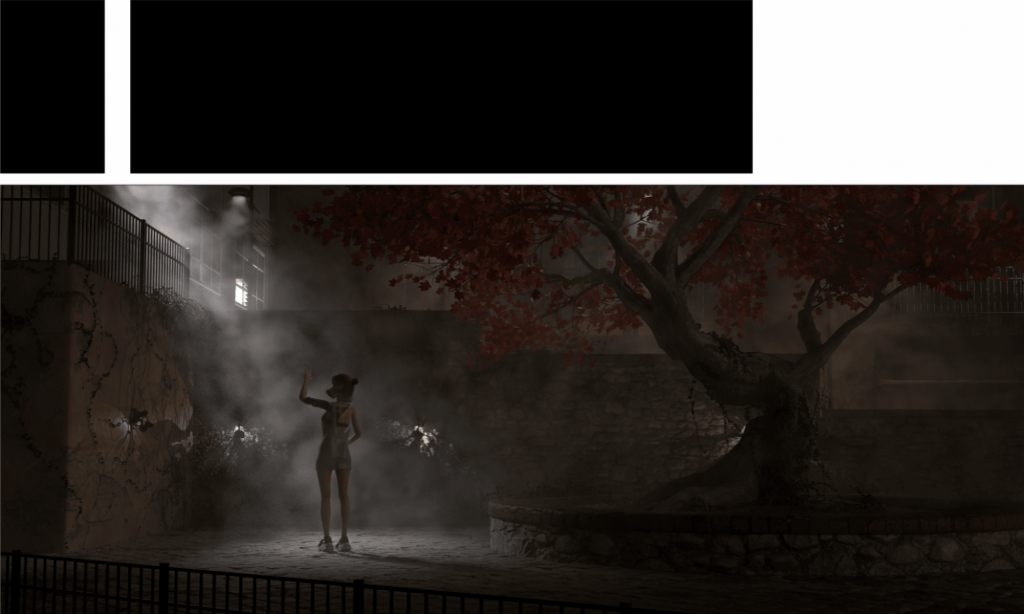
In this lesson I tried to build a similar interior environment, drawing detailed replacement maps and normal maps. I also used Maya’s fabric system to simulate a wind field.
Due to time constraints, I was not able to add more detail to add realism to the image. But I did get to practice the process of modelling in Maya and even experienced the dynamics module of Maya.
Read suggested material:
According to The VES handbook of visual effects: Industry-standard VFX practices and procedures, I understand the professional definition of Visual effects and special effects. Furthermore, The book also analyzes the reason and what time should we use the visual effects.
Research the different job roles in the VFX industry:
Runner: It’s a friendly position for a beginner in the VFX industry. The position is not necessary to handle advanced skills and don’t need any experience. Their responsibility is to serve the professional staff and make the environment well. They need to clean the room, prepare tea or cafe, transfer messages between different departments and so on. During this time, the runner also can know more information about the industry and build their knowledge.
prep artist: It’s a foundation job for fixing the footage and preparing all work for advanced visual effects. In my opinion, the mechanized tedious work will cost the compositor’s time, so allowing the newcomer to pre-post the simple problem in the footage is a good way to save the project’s budget.
Roto artist: the position is a little more complex than the prep artist. Roto artists are required to have a higher level of skills to handle some specific issues such as removing certain objects in parts of images. it is different with prep artist who is removing the boom microphones or electric pylons. the Roto artist needs a higher level of artistic sophistication.
Modelling Artist: The main responsibility of the position is to create digital 3d resources. Advanced modelling artists need to have rich life experience and broad biology knowledge. Such as the characters modelling, the artist needs to know the structure of humans. Even they have some concept references, they also need to decide how to build the detail which is important for the integral image.
Animator: On top of the modelling, the animation requires more skills. The animator needs to learn the principle of animation and make a correspondent rig for models. Furthermore, they also need to make a dozen controllers to achieve a specific action.
Texture artist: The position needs more skill in painting and hand arts. They need to know the principle of physical light and how the light work in a certain render. Besides, they also need to grab the points of different surface types, such as the car paint, metal, skin and so on.
Layout artist: The Layout artist need to determines the position of the virtual camera and they need to know how to set a shot, camera angle or camera path and so on. In 3D animation, they need to make a decision about lens, camera angles and camera movement otherwise, they also need to be directed by the director and learn the desired style of visual photography for the animation. A example of the layout artist is Marta Jimenez https://www.brownbagfilms.com/labs/entry/meet-layout-artist-marta-jimenez-interview, in her interview, she describe what she did for the job of layout artist.
Matchmove artist: The staff’s main responsible is matching computer-generated scenes with shot made by real camera. A good match move artist need to finish a convincingly combined with correct position and angle match, correct shadow and light, even include lens distortion. Such as the video The match move artist need match visual object to the real scene.
Lighting artist: The lighting artist will create a environment in 3D virtual scenes to make them look like real when the virtual match to the camera shoots. They need to change the light colour or place some lights to create a similar atmosphere. As the video shown, the function of lighting artist not only make the object look real but also express characters’ emotion by colour temperature.
CG Supervisor: They need to create a plan in advanced for the VFX work, such as the VFX area in different shot and how to create them. Then, they need make the VFX pipeline to make sure all the CG imagery will be created well. The video, describe what make a good CG Supervisor well.
Look development artist: The staff to make sure the Material look well in other different conditions. A certain surface designed by the concept arts still show different reflect in different environment. The Look development artist have to make sure the surface look good even in raining day or some specific lighting areas. Such as the demo, The Look development artist have to make sure the surface performance well in dark or underwater.
VFX supervisor: The VFX Supervisor will manage the whole VFX pipeline and they have ultimate responsibility for all the VFX elements. Besides, They also need to help for the relationship between a VFX studio and the director or producer of the film.
Data capture technician: They take photographs of the set and the way the cameras are positioned. They “capture data” about the type of lens type being used, its focal length, filters, focus and colour temperature. They also record the camera height, camera mount and distance between the camera and actor, and other details. And they take photos of surfaces, so that the textures can be recreated digitally later on.
Compositor: They use all the different digital materials, such as computer-generated images, live action footage and matte paintings, and combine them into one cohesive image and shot. Composers consider the visual aspects of a scene. Realistic lighting is one of the keys to this. Anything caused by light hitting the camera is the composer’s responsibility. They relight to improve the look of the image.
Compositing supervisor: The compositing supervisor is responsible for the department that puts together all the different elements of the visual effects shots. They manage the compositors that do this work and check their quality. Composition supervisors are experienced in composing. They organize teams of composers to meet deadlines so that the film or TV production company gets the VFX work on time. They can also composite their own footage if needed.
FX TD: The Effects technical director need create effect temple or tools such as explosions, billowing or smoke and water. Then the arts can directly use these tools to create convincingly scene. The position will fix the technology problems in pipeline.
TD (Assistant technical director): The Assistant technical director need to connect different departments and ask them the question in producing. The occupation like a node to transfer information between different departments and make sure they know each others’ job and problems.
Software developer: The Software developers create systems that the technical director can use and modify to suit to the specific needs of their VFX artists. They also design new digital tools and ensure they fit into existing software systems. This allows assets to be efficiently passed from one VFX process to the next.
https://www.screenskills.com/job-profiles/browse/visual-effects-vfx/technical/software-developer/
Pipeline TD:The Pipeline TD ensures smooth operation of VFX projects by identifying and fixing problems. They communicate with the entire team of VFX artists to understand their needs. They then put things in place to ensure the project runs smoothly and meets the needs of the artists. If the project is not running smoothly, they determine which tool needs to be developed to solve the problem. Problems that arise may be technical issues related to 3D art or productivity issues. Their work includes writing or modifying code to fix the problem.
i.Rigging TD (rigging technical director) : A Rigging TD is responsible for creating digital skeletons for 3D computer-generated models. They work to program these digital skeletons so that they move in a realistic way, and this is then used by Animators as a basis for their character’s movements.
ii.Creature TD (creature technical director) : the Creature TD work under the direction of the Rigging and Creature CG Supervisors, are responsible for setting up skin, muscle, cloth and hair on our hero-creatures. Tasked primarily to develop and design the tools and setups to tackle the challenges associated with a variety of Creature complex deformations. Our Creature TDs are a balance of technical and creative who are capable of scripting pipeline tools to streamline our shot-making processes.
iii.VFX Producer: The role of a VFX producer in the post-production process is to guide this work through the studio pipeline. The position is varied and involves many aspects. Key characteristics of a successful VFX producer include a business-savvy mindset, strong leadership skills, the ability to multitask, and creative insight. Additionally, a solid foundation in technical knowledge can help a VFX producer play an influential role with key stakeholders throughout a project.
iv.Production Manager: As the VFX Production Manager, they will be responsible for managing artists, schedules, and daily tasks. They will work in conjunction with VFX Producers and VFX Supervisors and They are also important in communicating with the producer of company shooting the live-action footage and producing the film or TV programme.
ii.VFX editor: VFX editors work as the link between the film or TV production team, which shoots the live-action footage, and the VFX studio that does the visual effects. They are the person who is overseeing, and responsible for all the visual effects in a production and they must have excellent communication skills, as the job requires the VFX editor to communicate effectively between VFX staff and the editors.
iii.Data input/output (I/O) technician: Data capture technical directors (TDs) go onto the film or TV set to collect the information about the live-action footage that the teams in the VFX studio need to add the visual effects.
iv.Concept artist: Concept art is the first and very critical step in the visual effects pipeline. Creating compelling design not just for creatures and characters but also for environments can mean the difference between a truly great film and a forgettable dud. They draw the characters or creatures and environments as well as vehicles, props and buildings. They begin with a brief, which might be a script, or the original concept of a film as told by its filmmaker.
v.Previs Artist (Previsualisation artist): Previs is a technical service typically done in 3D that allows a production team to realistically lay out or visualise the scenes in a way that technically makes sense. They generally takes the form of a 3D animatics, namely a rough version of a scene or scenes.
which job role or roles interest me the most and why?
As I said in the first week, The job of Effects technical director(FX TD) was impressive because being an advanced FX TD is my dream for my personal career and this is also the reason why I chose to study computer technology for my bachelor. According to the presentation of Mr Dom Maidlow, the FX TD role need to involve a mix of art and technological competencies.Furthermore, both technical skills and an appreciation for existing animation and effects need to be developed. I understand that FX TD requires a deep technical background, and I’m working hard to build up my knowledge and skills now. Because of my long exposure to a wide variety of the visual effects, I am good at dividing FX shots and mastering the rhythm of production. Another essential factor is the knowledge of scripting languages such as Python and C++ and programming skills dictate that I can be more flexible in creating tools to help with effects work.
Let’s go back to the 2020 Nvidia launch for a moment, the lifelike announcement is good enough to fake it. The emergent technologies, Omniverse, are used for the announcement of the simulation. This new technology focuses on the animation part and the other part such as modelling is almost the same as before. Thousands of photographs were taken from different directions using a large number of cameras when making the model of the speaker. Same as before workflow, using Maya and Zbrush to make a visual character. Then it’s time for the technical climax, building on the original audio-driven animation technology, NVIDIA has adopted the new Face video to video technology. In simple terms, the technology maps a captured real video onto a virtual model. The realistic real-time textures reduce the uncanny valley. The consequent problem is that the light source of the mapping is fixed so that the highlights do not move correctly with the camera when the view is rotated in 3d software. The Nvidia used AI deep learning techniques. Instead of calculating light changes through a physical renderer, multiple videos were shot in advance for the computer to learn the distribution of highlights at different angles. Although this approach cannot calculate real-time light but for global lighting, getting results that look realistic is what we are ultimately aiming for. A similar method is used for the capture of body action. The speakers were asked to perform several times and videos of the performers’ previous presentations were used to learn the performers’ movement habits. After learning by the computer, once the speaker’s voice has been captured, the action can be selected from the corresponding actions. Each syllable corresponds to a number of different actions, and after computer calculation, different actions are selected to correspond to different scenes. Once Nvidia has enough character action models, it will be possible to directly use actions that match the character’s personality in the future in the film, television or gaming industries. This workflow will significantly reduce the product development cycle.
There are of course limitations to such a technology, as there are scenarios where humans use a particular language of movement to express emotions, which the technology is currently unable to do. And the light mapping by deep learning is very limited, if there are other special light sources in the scene, the computer will get incorrect results, because the result is not obtained by real light calculation. But I believe the cutting edge technology of the future will better help artists create their work.
I will start my analysis with a relatively simple film in the war genre. The first movie is the Three Kingdoms: Resurrection of the Dragon (2008) which is released in China and another one is Flags of Our Fathers (2006) which is released in America. Both two films describe a fight between two countries.
The first film follows the legendary life of Zhao Yun, the famous general of the Shu Han Dynasty during the Three Kingdoms period in ancient China. In his early sixties, Zhao Yun, a famous general of the Shu Han Dynasty, returns to the mountains in order to help Shu recover the Central Plains and unify the country, only to be surrounded by the Wei army on Mount Fengming and to face the last battle of his life. Faced with internal and external problems, even Zhao Yun’s resourcefulness could not save him from defeat at Wei.
The Father’s Flag film depicts the background of the acclaimed photographic work ‘Raising the Flag on Iwo Jima’ which represents the Battle of Iwo Jima. It tells the story of the 5th U.S. Navy Division’s attempt to capture the heights of Iwo Jima in 1945, which was stalled until the fifth day when American troops were badly killed and wounded, and the Japanese were forced to retreat to the island’s caves. The whole process was met with fierce Japanese resistance and heavy losses on both sides. Finally, after a month of fighting to the death, the American flag was planted at the highest point on the island.
I chose the Chinese landmark science fiction film, Wandering Earth to analyze the images.
The film includes a close-up depicting a wounded grandfather sacrificing himself so as not to drag his grandson and granddaughter down.
The setting of the sense is in an abandoned skyscraper. In the future, due to extreme weather changes, most of the once existing buildings will be covered in snow and ice. The harsh climate has forced humans to bring along closed protection and oxygen. The most important prop in this image is the oxygen mask which has been removed. The protagonist could have just waited for the oxygen to run out and died logically, however, he chose to remove his oxygen mask to breathe the oxygen that was once. This prop helps shape the character’s mental activity and make audiences understand the character’s personality.
For the costume, the space suit-like design of the protective suit represents the harsh environment from the side. As the same time, The hardened exoskeleton assist system also reflects a certain level of technology
This is a moving shot from close-up to extreme close-up. This shot shows the character’s facial expressions very well. The rich facial detail conveys the memory for the good old days and the worry and blessing for the comfort of his grandchildren. The body language shows the satisfaction of inhaling the air of his homeland and the action of turning back express the attachment to children.
The lens uses low key lighting created by a backlight. The contrast in brightness between the background and the subject outlines a clear silhouette. Blue tones and low saturation sets an icy atmosphere. Although, I think having warm colours added to the scene when the characters are feeling relieved, makes the whole picture more layered. Instead of a constant cold colour palette. In addition, the whole figure is also in the very centre of the frame and then shifted to the left of the frame leaving a blank area to the right. The image can capture the audiences’ attention and lead the viewer’s eyes to the next frame.
After last week’s study, I have a deeper understanding of the properties of colour and specific nodes of the Nuke. I am more sensitive to colour because I have some experience in photography. Both Photoshop and DaVinci are some of the colour posting software I use regularly. Fortunately, both DaVinci and Nuke are node-based operating software, so many functional nodes are similar. Such as the picture I finished this week show.
I prefer to let data flow between nodes than a hierarchical structure of software. Therefore, I enjoy the greater freedom to adjust parameters in Nuke. I also tried the node that I learned In last week like the picture below.
Especially for the nodes of unpremult and premult, I was never quite sure of the slight difference between these nodes before. By understanding the principles, I have a better understanding of the mechanism by which the RGB and Alpha channels operate within the software.
In week 7 I have tried to make a new human model based on the DAZ 3d. I chose the base model body from Daz3D and started to edit the head in the Zbrush. The first step is to add detail to the ears, eyes mouth, nose and so on. When increasing the object subdivide level, the head needs to be added appropriately detail. Then I used the XYZ human textures to paint different textures in Mari.
I have thought that my PC which contains more than 200G Ram is enough for a high subdivided level in the Zbrush, however when I import the displacement into the whole body in level 7 subdivide the Zbrush notices that my PC has insufficient Ram for processing even the RAM only used around 50G (25%). I have to separate the head and body to handle the problem and I must care about the problem multitexture between the sew parts of two objects. Some problems in the side of different UDIM testures like the blow picture show. There is a obviously edge to divide the model.
Throughing the Layer and morph target, I fixed the mainly problem. After I export the displacement, it also need to be mixed in Photoshop carefully and I get the result like the picture below.
For the animation part, both the building controner or skining the animation is not easy. After I know the principle and basecial step to make shape blend, I use the Advanced skeleton to make the joint and controners and paint the skin by the ngSkintool.
Recently I joined short video teamwork for a certain one’s graduation product. After frequency communication, I have further understanding of how important the workflow or the standard work pipe is. Someone only transformed the .mb file to me however, when I tried to load the scene the system notice I lack some reference and colour manage files. In other respects, I found that not everyone knows about the whole workflow even don’t know what the next step needs to do. This is the problem that they can not export the appropriate format file for the next process.
For this week what I learned, the animation module of Maya has always been my weak point. Not only the skills of the Joints, Skins and Controller but also the principle of the animation. Some essential tiny animation of humans is hard to obvious but this small shake or front swing make the animation look vivid and realistic.